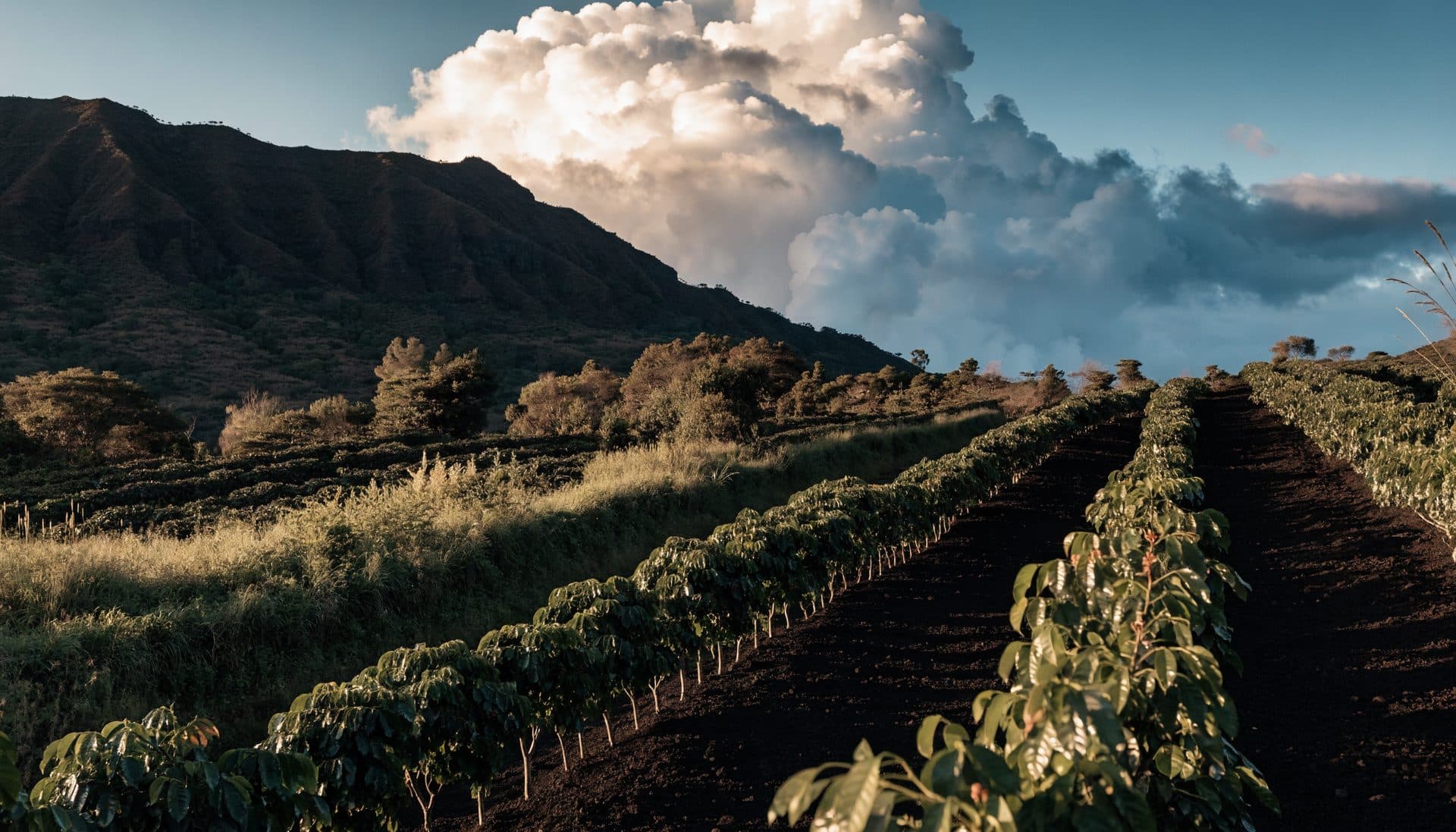
Illustration — not a named farm.
Field guide
What elevation on a Kona bag actually tells you
Elevation on a Kona bag is a west-side farm altitude note, not a roast style and not proof the bag is 100% Kona.
Elevation on a Kona bag is a west-side farm altitude note. It tells you roughly where on the slope the cherries grew. It is not a roast style, not a grade medal, and not proof the bag is 100% Kona Coffee.
A farm altitude note, not a roast
Kona coffee that can honestly wear the name grows in a narrow belt on the leeward slopes of Hawaiʻi Island. North Kona and South Kona, out of the worst of the trade winds. Farms stack along that strip, a few hundred to a few thousand feet up, depending on the lot. That range is geography. It is small by world coffee standards. Drive it and you feel how short the real map is.
When a bag prints something like “2,000 ft” or “estate elevation,” it is usually pointing at that belt, not at a darker roast or a secret ranking above Extra Fancy. Roast still changes the cup. Elevation does not create the origin. You either grew it on that west-side slope or you did not.
Why the west-side belt talks about feet
Elevation matters because the weather on that belt is not the weather at the beach. Mornings can run bright. Clouds and rain often move in later. Nights cool off. Cherries take their time. None of that is a slogan you can roast into a cheaper bean from somewhere else.
People who buy 100% Kona for a mild, sweet, clean cup are buying place and care, not a number on a sticker. A higher printed elevation does not automatically mean a better bag. A lower lot on the same belt can still be real Kona. Compare farms, roast dates, and the identity line, not feet alone.
What elevation is not
It is not a roast. “Kona roast” and “Kona-style” are still style language. Useful for color. Useless for place. More: What Kona actually means.
It is not an HDOA grade. Extra Fancy, Fancy, No. 1, and Peaberry are sorting words about green beans (size, defects, type). Elevation is not on that sheet. More: How to read a Kona bag and What peaberry actually means.
It is not a blend-fixer. Elevation printed on a 10% Kona coffee blend describes, at best, the Kona fraction. Until 30 June 2027 that blend can be as low as 10% (HRS §486-120.6 / Act 198). From 1 July 2027, using a Hawaiʻi geographic name means at least 51% from that origin. Start with “100% Kona Coffee.” More: 100% Kona vs the blend.
It is not a farm name. If there is no estate or mill you can look up, you still have a brand, even if the bag shouts feet.
Still read the bag in order
- Identity line: “100% Kona Coffee,” or stop.
- Farm, estate, or mill you can actually look up.
- Roast date, not only a best-by from next year. More: Roast date vs best by.
- Grade words and elevation last: useful context, not the literacy test.
- Price as a smell test. Genuine 100% Kona on farm sites commonly $30, $60+/lb.
FAQ
- Does higher elevation mean better Kona?
- Not automatically. Elevation is where on the west-side belt the lot sat. Taste the cup. Read 100%, the farm name, and the roast date first.
- Is elevation the same as Extra Fancy?
- No. Extra Fancy is a green-coffee grade. Elevation is farm geography.
- Can a blend print an elevation?
- Yes. The elevation does not rescue the percent. Read the identity line.
- Is “Kona roast” an elevation claim?
- No. It is style language, like French roast.